 Slovenský

Floor plan from 1877, author: Viktor Myskovszky

- Castle tower (the oldest building in the castle)
- Gothic castle palace
- Castle courtyard
- Small corner bastions
- Cannon bastion to protect the entrance road
- Cannon bastion to protect the entrance gate
- Probably farm buildings
- Entrance gate
Description, floor plan of the castle
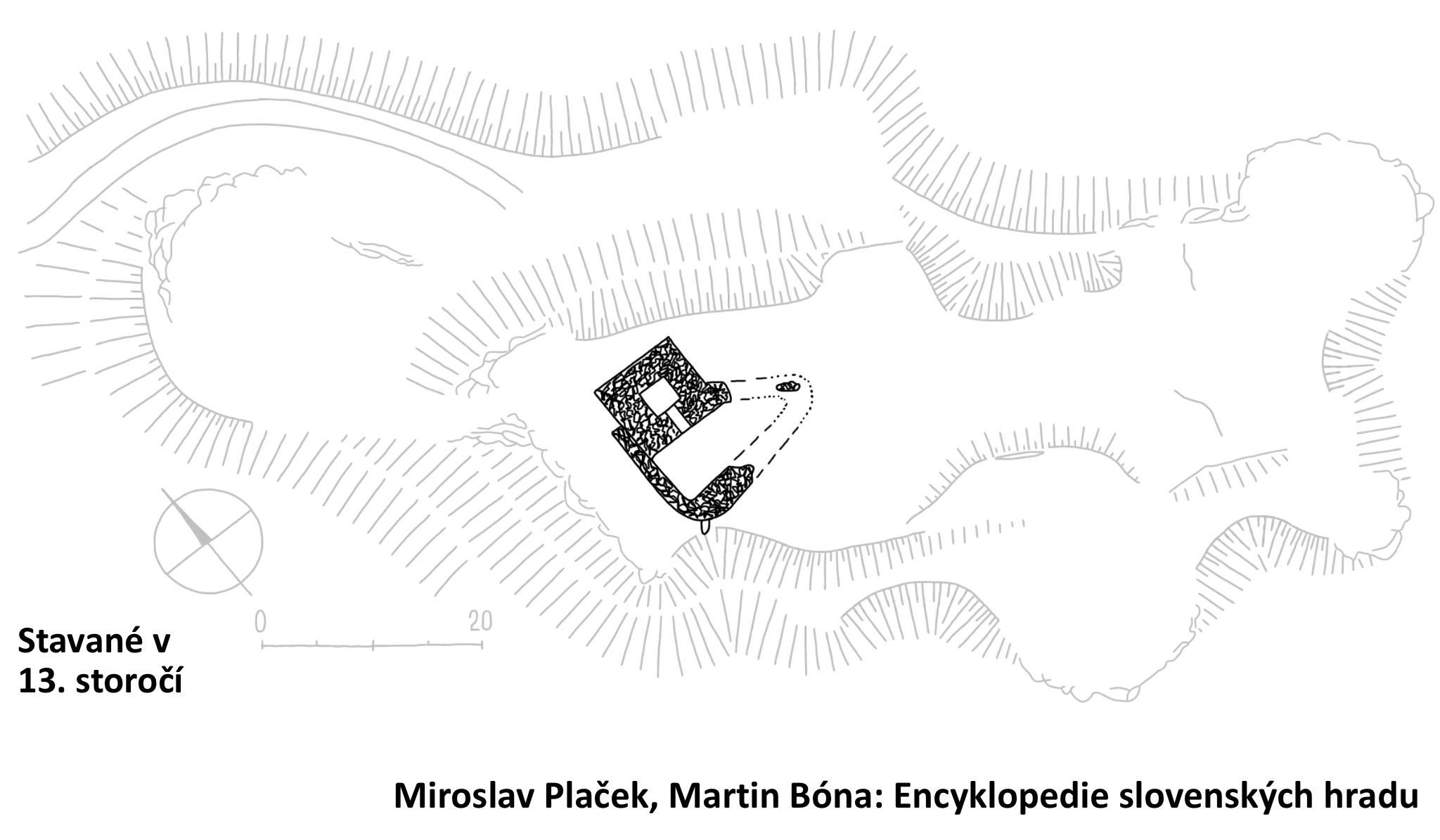
Rough analysis of the castle’s development (according to Miroslav Plaček, Martin Bóna: Encyclopedia of Slovak Castles):
- built in the 13th century
- built after 1357
- first half of the 15th century
- 1540 – 1550
- end of the 16th century
- later
Foundation and the Tekuš family (Tornai)
1357 | King Louis I the Great granted Ladislav (son of Ján from Turna) and his brothers Egíd and Ján permission to build a castle (stone or wooden) for their loyal services. They belonged to the old Tekuš family (later they began to use the predicate “from Turna” or Tornai). During this period, a Gothic residential palace and a 10-meter high wall were built on the site of today’s upper castle. |
1340 – 1406 | Various branches of the Tekuš family own estates. |
March 1406 | Ladislav’s son Ján dies childless. The castle passes into the lifetime use of Ladislav’s widow. |
The Era of Sigismund of Luxembourg
May 1406 | The Tekuš family protests against the violent and illegal occupation of the castle by King Sigismund of Luxembourg. The king seizes the castle and hands it over to the Polish nobleman Mostic from Malé Ctiborice (a relative of his favorite Ctibor). |
March 1409 | Sigismund exchanges the castle. He takes the Kővár castle and in return hands over Turna to the former ban Paul Bešeň (Besenyő) and royal treasurer Štefan Šafár. |
1414 | Paul and Štefan divide the property. The castle goes to the turnian governor Paul and his wife Apolónia. In these years, the castle is managed by castellan (Juraj, Folkos, Juraj Horvát, Matej from Točany). |
1436 | Paul’s son Mikuláš dies without male heirs. King Sigismund takes advantage of the fact that the owners missed the deadlines for legal arrangements in 1410 and takes the castle back. Štefan from Nádasd and Ladislav from Hangony are appointed as castellans. |
1436 – 1437 | The castle briefly passes into the ownership of Queen Barbara (Sigismund’s wife). |
The Habsburgs, the Brothers and the House of Zápoľský (Zápolyai)
1438 | King Albert of Habsburg returns the castle to Štefan Šafár and his son Silvester (who later wrote himself as Silvester ‘of Turna’). Silvester abuses his power during the unrest. |
1453 | The attack of the ‘brothers’ (former mercenaries of Ján Jiskra of Brandýs). They kill the castellan Vida and attempt to capture the castle using ladders, but unsuccessfully. |
1456 | Margaréta, the widow of Silvester, writes a letter from the castle to the famous preacher, Saint John of Capistrano. |
The 60s of the 15th century | After the death of Silvester and his brother Vitus, their descendants begin to sell off their properties. |
1471 | Štefan (Silvester’s son) is preparing to sell the castle. Soon, a high-ranking church dignitary — Archbishop Ján Beckensloer — buys the castle back. |
1476 | Archbishop Beckensloer departs to Salzburg and sells the castle for 10,300 gold coins to Palatine Imrich Zápoľský, his wife Uršula, and brother Štefan. |
1476 – 1526 (the periodof the Zápoľský family) | The castle belongs to the Zápoľský family until the battle of Mohács. Under Štefan Zápoľský and his son Ján (the future king), the castle undergoes significant modernization: the palace is expanded, an outer defensive curtain wall and a residential defensive tower are built in the front. Until 1502, Imrich Himfi served as castellan, followed by Juraj Literát, and the last medieval castellan (until 1526) was Mikuláš of Drienčan. In 1526, the castle was controlled by Štefan Verbőci (a supporter of Ján Zápoľský). |
The Renaissance Period: Gašpar Horvát and the Magóci Family
November 4, 1527 | King Ferdinand I of Habsburg gifts the castle to his chamberlain Gašpar Horvát amid the civil war. However, he effectively gains control over it only at the beginning of the 30s of the 16th century. |
March 31, 1535 | Ferdinand I appoints Gašpar Horvát as the head of the Turna district. |
June 12, 1540 | The king issues a new deed of gift to Horvát and his wife Jana Likerka, allowing inheritance of the castle through the female line. |
January 20, 1549 | After the death of Horváth, Ferdinand I allows the widow to freely manage the property. |
November 21, 1559 | The widow sells the castle and estate for 14,000 Hungarian gold to the county chief Gašpar Magóci (Mágócsy) and his brother Tomáš. |
Second half of the 16th century | During this period (probably under Horváth or Magóci), the castle transforms into a massive artillery fortress. A huge semicircular bastion (*torion*) with walls up to 5 meters thick, as well as towers with protruding “trouser” gunports, was built. |
Unrest and division of the castle (End of the 16th – 17th century)
Until 1582 | Žigmund Rákoci (Rákóczi) unlawfully occupies the castle after marrying Judita Alaghyová (mother of František Magóci). |
March 22, 1603 | Žigmund Rákoci formally returns the castle to the Magóci family for a huge ransom of 50,000 gold. |
Beginning of the 17th century(after 1611) | With the death of František Magóci, the castle passes through the female line to the Kátai (Michal Kátai) and Móric (Peter Móric) families. The castle is effectively divided into two equal halves. The owners live in the manors below, and the castle is used as a garrison, prison, and storage. |
April 28, 1621 | An inventory of Martin Móric’s half is compiled. A “cabbage cellar,” storages for bacon, flour, and weapons (78 matchlocks) are mentioned. |
December 20, 1621 | King Ferdinand II confirms the rights of Martin Móric and the Kátai family. |
August 16, 1625 | The king confirms the inheritance rights of Móric’s daughters, one of whom (Barbora) marries Mikuláš Keglevi (Keglevich). |
The Era of the Keglevi Family and the Final Decline
February 28, 1647 | King Ferdinand III issues a donation deed to Count František Vešelényi (Wesselényi) in case the Móric family becomes extinct. |
November 27, 1659 | Vešelényi transfers this right to Mikuláš Keglevi, which is confirmed by King Leopold I on March 12, 1662. |
1671 | Half of the castle belonging to František Kátaim is confiscated for participation in Vešelényi’s conspiracy. |
August 9, 1677 andApril 16, 1678 | Leopold I grants Kátai’s portion (as well as the rights of the extinct Móric family) to Mikuláš Keglevi for loyalty to the Habsburg dynasty and the payment of 30,000 gold coins. Thus, Keglevi acquires 3/4 of the castle. |
May 12, 1692 | After Mikuláš’s death, his son Adam Keglevi becomes the county head. Brothers Adam and Žigmund Keglevi purchase the last quarter of the castle from the Šemšei family (Semsey) for 10,000 gold coins. |
August 15, 1699 | King Leopold I officially donates the entire castle to the Keglevi brothers. By that time, the castle was already in ruins. The Keglevi family (especially Jozef Keglevi, the county head from 1720 to 1763, and his son Jozef, the county head from 1767 to 1792) preferred life in a more comfortable mansion at the foot of the hill and did not restore the fortress. |
18th – 19th century | The castle quickly deteriorates, its ruins attract the attention of romantic artists and architectural historians. |